

Under the Hood: Defense-in-Depth Architecture
Modern system design operates under the Zero Trust security paradigm: assume the perimeter is already breached, network transport is inherently hostile, and every request must be authenticated, authorized, and continuously validated. Relying on a single firewall or border proxy creates a catastrophic single point of failure.
Layered Defense Perimeter
Production Abuse Mitigation Vectors
1. Credential Stuffing & Automated Bot Mitigation
Malicious actors weaponize billions of leaked password dumps to execute automated distributed brute-force attempts against login and authentication endpoints. Defenses include TLS Client Hello (JA3/JA4) fingerprinting to identify headless HTTP client scripts, IP reputation lookups, and progressive behavioral challenges (invisible CAPTCHA) triggered when request anomalies exceed threshold limits.
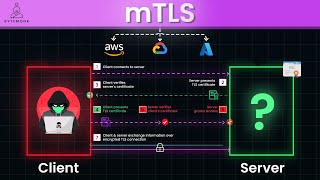
2. Mutual TLS (mTLS) & Workload Identity
Inside the cloud datacenter, plain unencrypted HTTP between microservices is unacceptable. Service meshes (Istio, Linkerd) enforce Mutual TLS (mTLS) with short-lived x509 certificates issued by the mesh CA or SPIRE and rotated automatically (Istio defaults to 24-hour workload certificates; SPIRE's default SVID TTL is 1 hour; both are configurable). Every service verifies the exact cryptographic identity of the calling service before granting RPC access.
3. Envelope Encryption at Rest
Data written to persistent storage is secured using Envelope Encryption: a unique local Data Encryption Key (DEK) encrypts the file or database row, and the DEK itself is encrypted by a root Key Encryption Key (KEK) locked inside a Hardware Security Module (HSM / AWS KMS). The plaintext DEK exists only in volatile memory during active encryption/decryption.
Threat-to-control map
| Threat | Layer | Control | Real-world example |
|---|---|---|---|
| Volumetric DDoS (UDP/SYN floods, amplification) | Network edge | Anycast absorption, scrubbing, SYN cookies | Cloudflare, AWS Shield, Google Cloud Armor |
| HTTP floods at layer 7 | CDN/WAF | Per-path rate limits, challenge pages, caching | Cloudflare and Google publicly reported HTTP/2 Rapid Reset attacks peaking at hundreds of millions of requests per second in 2023 |
| SQL injection, XSS, SSRF | WAF + application | Parameterised queries, output encoding, egress allow-lists | OWASP Top 10; the 2019 Capital One breach involved SSRF against cloud instance metadata |
| Credential stuffing, account takeover | Auth service | Per-account throttling, breached-password checks, MFA, risk scoring | Have I Been Pwned k-anonymity range API |
| Lateral movement after a breach | Service mesh | mTLS workload identity, per-service authorisation policy | SPIFFE/SPIRE, Istio, Google BeyondProd |
| Stolen disks or snapshots | Storage | Envelope encryption with KMS/HSM, key access logging | AWS KMS, Google Cloud KMS, HashiCorp Vault |
Worked example: credential stuffing against a login endpoint
An attacker has 5 million leaked email and password pairs and a pool of 40,000 residential proxy IPs. They send 1 million attempts per hour.
- That is only 25 attempts per IP per hour, below a per-IP limit of 100 per hour, so IP limits alone do nothing.
- A typical reuse success rate of about 0.1% to 2% means 1,000 to 20,000 accounts taken over per hour if nothing else stops the attack.
- Controls that do work: count failures per target account (for example 5 per 15 minutes, then add friction). Watch the global login failure ratio, which jumps from about 5% to 95% during an attack, and trigger challenges for the whole endpoint when it does. Check submitted passwords against breach corpora. Fingerprint clients by TLS characteristics (JA3/JA4) and HTTP header order, and require MFA for risky logins.
- Return the same error and roughly the same response time for "unknown user" and "wrong password", so the endpoint does not reveal which accounts exist.
Envelope encryption, step by step
The root key never leaves the HSM, and every decrypt call is authorised and logged. Rotating the root key does not require re-encrypting the data, because only the data keys are wrapped with it.