

Parallel monolith read drain
A legacy monolith can overload its primary database with reads simply because its default connection points there. Many of those queries may tolerate a replica's delay, but changing every old call site could take months. Moving a few suitable routes can buy time for that cleanup.
The useful boundary is the running application: give a second copy a different database configuration, then control which requests reach it. First choose eligible routes, then measure whether moving them actually relieves the primary.
Same code, different default database
Keep the existing fleet pointed at the primary. Run another fleet from the same application code with its default connection pointed at a replica. An API gateway sends selected read routes to the second fleet; writes and all other routes stay on the existing path.
| Application fleet | Default database |
|---|---|
| Existing monolith | Primary |
| Read-drain monolith | Replica, with read-only credentials |
monolith] G -->|Eligible reads| R[Replica-default
monolith] W --> P[(Primary)] R --> S[(Replica)] P -. Replication .-> S
Route by both path and method. Gateway support for GET /catalog does not imply that POST /catalog should reach the same backend. KrakenD, for example, lets endpoint definitions select a method and backend. That supplies a routing mechanism; it cannot tell you whether the application behind a route is safe to move.
Choose by behavior and freshness
“GET” is not enough. A handler might update a last-seen timestamp, create a missing row, refresh a token or publish an external event. Read-only database credentials help reject accidental database writes, including after a replica is promoted. They do not prevent external side effects.
A route also needs a freshness contract. An asynchronous replica can return a state from before an accepted write. Decide whether that is acceptable for the particular answer:
| Possible candidates, after inspection | Keep on the primary unless stronger guarantees exist |
|---|---|
| Catalog descriptions with an accepted delay | Checkout confirmation immediately after payment |
| Profile display where a delayed edit is acceptable | Balance or entitlement decisions requiring current state |
| Dashboards that show their data freshness | Read-modify-write and idempotency endpoints |
For read-after-write flows, retaining the primary route is often the simplest first choice. The replication lesson examines other freshness strategies. Do not silently weaken the product's behavior merely to move more queries.
Move one route and watch both databases
Start with primary read work attributable to the route: request volume, query volume and expensive queries. Establish enough replica capacity, then route a small population through the second fleet. Watch the primary's work, replica replay lag, endpoint errors and p95/p99 latency together.
A replica can be healthy and still give users a poor answer. In PostgreSQL hot standby, long queries may conflict with WAL replay; letting them run can delay replay, while applying replay can require canceling them. A read drain therefore needs evidence about cancellations and freshness as well as CPU.
Shadow reads are an optional earlier step: keep serving the old answer while privately comparing the new one. They add work, so bound the sample. With separate databases, two requests do not automatically share a snapshot. Differences can mean expected lag, a query bug or an incompatible representation; classify them before deciding what blocks rollout.
Expand the route list only when the expected primary work falls without violating those route contracts. Keep enough primary capacity to take the traffic back. Reverting a gateway rule can restore routing while the old path remains compatible; it cannot undo stale answers already delivered.
Try the serving decisions locally
The following experiment isolates comparison, cutover and fallback. It uses the migration lesson's three orders and two representations in one SQLite database. It runs real read/write HTTP listeners, but it does not deploy two monoliths, a gateway or a database replica.
Ada is selected for the new read path; Bo stays on the old one. The local router checks current source ownership, account activity, deletion state, version and a canonical-record fingerprint before serving a copied body. It therefore still queries the source on every request. This demonstrates a strict acceptance rule, not reduced primary load.
The example separates three target failures: missing means no copied record, stale means a different version, and mismatch means changed contents at the current version. Old-served shadow comparisons use one shared SQLite snapshot here, so they do not have the cross-database timing ambiguity described above.
Save the read-drain replay and shared implementation together. The original capture used Python 3.14.6 and SQLite 3.53.4 on 12 September 2026. Each run creates temporary state.
python3 m27-lab.py drainold served; shadow check: 200 equal
missing shadow: missing
wrong-value shadow: mismatch
Ada cohort new read: 200
stale target fallback: 200 paid stale
caught-up new read: 200
missing new fallback: 200
fallback disabled: 503
Bo remains old cohort: 200
Bo reads Ada object: 404
current Ada revocation: 403
write on read-only listener: 405
rollback cohort: []
route work: {"fallback":2,"new":2,"old":4,"refused":1,"shadow":4}
shadow log fields: classification only; no response bodies
HTTP outcomes: {"200":8,"201":1,"403":1,"404":1,"405":1,"503":1}After the new writer changes Ada's order, the target is stale. Fallback returns paid from the authoritative source. Disabling fallback makes an unusable target return 503. Bo cannot read Ada's order, a revoked Ada cannot read her own, and the read listener rejects writes.
The four shadow checks are additional comparisons attached to old reads, not four more user responses. The thirteen HTTP outcomes include the accepted write and permission/method refusals. Diagnostic logs retain comparison classes, not copied response bodies.
Decide what happens when the replica falls behind
Fallback trades freshness and availability for extra primary work. During a replica problem, unbounded fallback can send the entire drained workload back at once. Budget that capacity and cap retries; where capacity is insufficient, the route needs an explicit choice between refusal and an older answer that its product contract permits.
A successful fallback should still count as a degraded new path. Otherwise a green response-success chart can hide a replica that serves almost nothing. Keep served-old, served-new, fallback and refusal counts separate.
Before adding another route, ask: if this replica pauses immediately after a write, what will the caller see, and can the primary absorb the return traffic? Answer those questions with the route owner. The complete migration design combines the local acceptance checks with copying, retirement and the point where the old fallback disappears.
Decommissioning Monolith Endpoints Safely
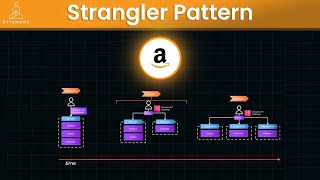
When extracting microservices from an existing monolithic application (the Strangler Fig pattern), abruptly switching all customer traffic risks catastrophic bugs. The Parallel Read Drain (Dark Launch) pattern validates the new microservice invisibly in production:
Dark Launching / Shadow Traffic
The API Gateway receives a user request and forwards it to the legacy monolith. Simultaneously, the gateway clones the request asynchronously (fire-and-forget) to the new microservice. Shadow only reads or idempotent calls (or point the shadow at an isolated datastore); duplicating a non-idempotent write such as a payment would execute it twice. A shadow comparison worker compares the two HTTP responses. Discrepancies are logged and fixed before any live user ever touches the new service.
The migration as stages
Each arrow is a gate with a numeric exit criterion, such as a mismatch rate, p99 latency and error rate, held for a soak period. Every stage can be reversed with a routing change alone.
Worked example: reading the mismatch report
The GET /orders/{id} endpoint receives 3,000 requests per second. After shadowing 100% of traffic for 24 hours, about 259 million pairs have been compared and 41,000 of them differ, a 0.016% mismatch rate. Grouping the mismatches by field shows:
- 28,000 differ in
updated_atprecision (milliseconds against microseconds). This is harmless, so normalise the field and ignore it. - 12,500 differ in currency rounding on orders with discounts. This is a real bug that must be fixed before cutover.
- 500 are read-after-write races, where the new service reads from a replica that is a few milliseconds behind. To handle these, compare again after a delay, or only compare records that have not changed recently.
Twitter's Diffy reduces noise by running two copies of the old version as well as the candidate. Differences between the two old copies are treated as noise, and only differences that appear between old and new are reported. GitHub's Scientist library applies the same idea inside application code: it runs the old and new code paths, returns the old result, and records any mismatch.
Comparison of approaches
| Approach | Where comparison happens | Good for | Limitation |
|---|---|---|---|
| Gateway shadowing (Envoy request mirroring, Istio mirror) | Offline, in a comparison worker | Read-only HTTP endpoints | Mirrored responses are discarded, so you must capture both responses yourself |
| In-code experiment (GitHub Scientist) | Inside the monolith process | Refactoring one code path | Adds latency unless the new path runs asynchronously |
| Traffic capture and replay (Netflix) | Offline replay of recorded traffic | High-risk migrations, load testing | Recorded data goes stale, and you need to scrub personal data from it |
| Dual write plus reconciliation | Batch comparison of the two datastores | Write paths | Needs idempotency and a single source of truth during the migration |
Draining the monolith
After the new service serves 100% of traffic, keep the monolith code path deployed but unused for one or two release cycles. Watch its request counter until it stays at zero, including traffic from forgotten internal callers, cron jobs and old mobile app versions. Then delete the code. The endpoint is finished only when the code is gone, so plan the deletion step as part of the migration.