
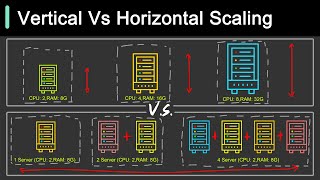

Under the Hood: Scale-Up vs. Scale-Out Physics
Scaling is the mechanism of expanding system throughput when inbound request volume exceeds existing processing capacity. The two foundational vectors—Vertical Scaling (Scale-Up) and Horizontal Scaling (Scale-Out)—impose radically different hardware, operational, and architectural trade-offs.
Architectural Comparison
Engineering Realities & Trade-Offs
1. Hardware Limits vs. Distributed Complexity
Vertical scaling upgrades existing nodes (e.g., transitioning an instance from 8 cores to 128 cores). It requires zero application code refactoring and introduces no distributed network latency. However, it hits a ceiling: the largest machine or instance size available, with diminishing returns from NUMA memory-node crossing penalties and memory bandwidth, and price premiums at the largest or specialised sizes (within an instance family, cloud pricing is roughly linear per vCPU). Furthermore, taking the single machine down for hardware maintenance produces instantaneous total outage unless paired with a hot standby.
2. Stateless Tiering as the Prerequisite for Scale-Out
Horizontal scaling adds commodity nodes behind a load balancer. It offers far more headroom and fault tolerance, although shared state, coordination and hot keys keep real gains below linear—if a worker node dies, health checks drop it from the pool without user impact. However, horizontal scaling requires the application tier to be strictly stateless: user sessions, in-flight jobs, and persistent data must move to external shared state layers (Redis clusters, distributed relational databases, or object stores).
3. The Hybrid Modern Standard
Production systems rarely pick one dogmatically. Modern engineering pairs vertical optimization with horizontal elasticity: right-size individual nodes for the workload (for latency-sensitive services, fitting within one NUMA node avoids cross-socket memory penalties, but the right size is workload dependent), then scale those standardized units horizontally behind load balancers.
Worked example: when to scale up and when to scale out
Suppose an API tier handles 2,000 requests per second at peak, and load tests show one 8 vCPU instance sustains about 600 requests per second at 60% CPU while meeting the latency target. Traffic is expected to triple within a year.
- Today: 2,000 / 600 is about 3.4, so 4 instances meet peak. To survive losing one instance (N+1) you run 5.
- Next year: 6,000 / 600 = 10 instances, 11 with one spare. The load balancer, health checks and deployment pipeline do not change; only the instance count does.
- Vertical alternative: one 64 vCPU instance might handle about 4,000 to 4,500 requests per second (rarely a perfect 8x, due to lock contention and memory bandwidth). It is simpler, but it is still a single point of failure, and a restart for patching is a full outage unless a second machine stands by.
The database behind it is a different story. If each request makes one indexed read, 6,000 reads per second is well within a single well-provisioned PostgreSQL or MySQL primary with read replicas. Scaling the database vertically first, then adding read replicas, then partitioning only when writes or data size demand it, is the standard progression.
Trade-off table
| Dimension | Vertical (scale up) | Horizontal (scale out) |
|---|---|---|
| Code changes | Usually none | Tier must be stateless or state must be partitioned |
| Failure impact | One machine failure is a full outage unless a standby exists | Losing one of N nodes removes about 1/N of capacity |
| Ceiling | Largest available instance size | Coordination and shared dependencies, not machine size |
| Cost curve | Roughly linear per vCPU within an instance family, jumps at the largest or specialised sizes | Linear in node count plus load balancer and operational overhead |
| Upgrades | Resize often requires a restart | Rolling replacement with no downtime |
| Best fit | Databases, early-stage systems, workloads needing large shared memory | Stateless web and API tiers, workers, caches with partitioning |
Failure modes to watch
- Hidden state: local file uploads, in-memory rate limit counters or caches that assume one node silently become wrong with several nodes.
- Thundering scale-out: an autoscaler that adds 20 instances at once can open 20 new connection pools against the database and overload it.
- Uneven load: long-lived connections (WebSockets) stay on old nodes after scale-out, so new nodes sit idle until connections are rebalanced.
How real systems do it
Stack Overflow famously served very high traffic for years from a small number of powerful SQL Server machines, a deliberate vertical choice for the database. Most large web companies run stateless application tiers behind load balancers and autoscaling groups, and keep sessions in a shared store such as Redis or in signed tokens so any node can serve any user.