
Decentralized Cluster Membership Without Central Coordination
In large-scale distributed clusters consisting of thousands of nodes (such as Apache Cassandra, Amazon Dynamo, or Consul), maintaining cluster membership via a centralized leader (like ZooKeeper) creates a scalability bottleneck. Gossip Protocols (Epidemic Algorithms) enable decentralized peer-to-peer discovery and failure detection with O(log N) message dissemination efficiency.
The Periodic Peer Exchange Flow
Under the Hood: Gossip Dissemination Patterns
1. Dissemination Types
- Anti-Entropy: Nodes compare their entire state trees (often using Merkle Trees) and synchronize missing deltas. Highly reliable, but involves higher network bandwidth.
- Rumor-Mongering (Dissemination): When a node detects an event (e.g., Node X is unresponsive), it broadcasts the rumor to k randomly chosen peers. Each peer forwards it to k other peers. Within O(log N) rounds, almost all nodes receive the update with high probability; exact coverage depends on fanout, message loss and when nodes stop forwarding the rumor.
2. The Accrual Failure Detector (Φ-Accrual)
Traditional failure detectors use a binary heartbeat timeout: if no ping is received within 5s, the node is declared dead. In lossy cross-datacenter networks, temporary network hiccups cause false-positive node churn.
Cassandra implements the Φ-Accrual Failure Detector (Hayashibara et al.). It records a sliding window of historical heartbeat arrival intervals, The original paper models them with a normal distribution; Cassandra simplifies this and approximates inter-arrival times with an exponential distribution based on the mean interval. It outputs a continuous probability metric Φ:
$Φ = -log10(Plater(t - tlast))$A larger Φ means the observed silence is less likely under the historical arrival model; it is a suspicion score, not a guaranteed false-positive probability. Applications choose their own risk threshold: a conservative storage coordinator can wait for Φ = 12, while a soft read cache can fail over at Φ = 4.
Worked example: how fast gossip spreads
A 1,000-node cluster, gossip interval 1 second, fanout 3 (each informed node tells 3 random peers per round). Ignoring overlap, the informed count roughly quadruples each round (1, 4, 16, 64, 256, 1,024), so about 5 rounds reach nearly everyone. Overlap slows the tail, so in practice expect about 7 to 10 rounds, that is 7 to 10 seconds, for effectively all nodes. At 10,000 nodes it is only a few rounds more: that is the log N property.
Bandwidth: if each exchange carries a 2 KB digest, each node sends 3 x 2 KB = 6 KB per second, regardless of cluster size. Compare that with all-to-all heartbeating, where 1,000 nodes send 999 messages each per interval.
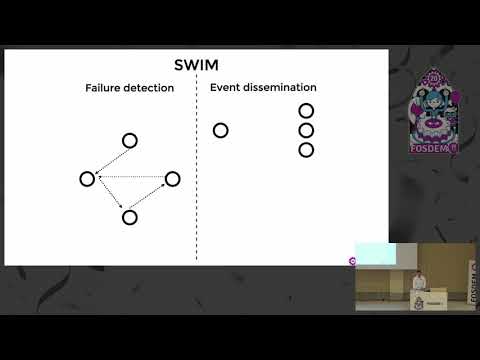
SWIM-style failure detection
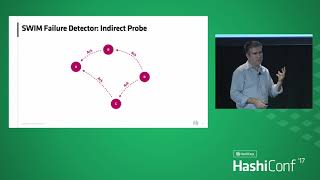
Indirect probing distinguishes "B is dead" from "the A-to-B path is bad". If nobody gets an ack, B is marked suspect, and that state is gossiped. B can refute it by gossiping a higher incarnation number. Only after the suspicion timeout is B declared dead.
Design choices
| Choice | Option A | Option B | Trade-off |
|---|---|---|---|
| What to send | Full state (anti-entropy) | Only recent changes (rumour mongering) | Reliability versus bandwidth |
| Exchange style | Push | Push-pull | Push-pull converges faster in the tail |
| Failure detection | Fixed heartbeat timeout | Phi-accrual or SWIM suspicion | Simplicity versus fewer false positives |
| Reconciliation | Version or heartbeat counters | Merkle trees | Merkle trees suit large data sets (Cassandra repair) |
Who uses it
- Cassandra: a gossip round every second with up to three peers, a SYN, ACK and ACK2 exchange, and phi-accrual failure detection (
phi_convict_thresholddefaults to 8). - Consul and Serf use memberlist (SWIM plus Lifeguard) for membership. Consul's servers still run Raft for the catalogue.
- Redis Cluster nodes gossip on the bus port (data port plus 10,000) to share slot maps and failure reports.
- Amazon S3 had a 2008 outage in which a single corrupted bit in gossiped state spread across the system. Checksum gossip messages.