
Clock skew and ID ordering
A time-bearing ID records a clock reading used during generation. Sorting those IDs can help browsing, but it does not establish the order of events across machines.
Two machines may disagree about the current time. Even when their readings match, worker fields and local counters break ties according to the format rather than the events' relationship.
Skew and rollback are different problems
A wall clock reports calendar time, such as Unix milliseconds. The offset between machines' readings at the same instant is commonly called clock skew. Drift and clock corrections can change that offset.
Rollback is a clock moving behind its own earlier reading. The course Snowflake generator detects this locally. It cannot detect that another machine is twenty milliseconds ahead, and ordinary clock synchronization does not by itself establish a strict event-order guarantee.
A process pause adds another complication: a process can generate an ID, wait, then store or send its record. Generation time, receipt time and commit time describe different events even without a backward clock adjustment.
Follow a request and its reply
Choose the following exchange. A generates the request's ID at elapsed time 1030; B generates the reply's ID at 1005; A records receipt at 1031. These are chosen readings relative to the course epoch, not measured network times.
B's reply depends on A's request, so the request came first in this exchange. Its smaller clock reading cannot reverse that dependency. Lamport's happened-before relation formalizes this using process order and actual message exchanges, without requiring matching wall clocks.
The Snowflake replay calls two generators in this order and retains explicit causedBy references. Its ordering mode also compares equal timestamps and two elapsed-time calculations. Node 24.11.0 reproduced the output on September 17.
node m09-snowflake-replay.mjs orderingobserved sequence: A sends -> B replies -> A receives
A sends: local_ms=+1030, id=4320202752
B replies: local_ms=+1005, id=4215287808
A receives: local_ms=+1031, id=4324397056
numeric ID order: B replies -> A sends -> A receives
same timestamp: worker 17 emitted first, smaller ID belongs to worker 3
chosen wall-clock difference: -100
chosen monotonic-clock difference: 10Both generators follow their local rules and use distinct worker identities. There is no duplicate: the failure is the interpretation of their numeric order. At an equal timestamp, worker 3 sorts before worker 17 even when worker 17 emitted first, because the worker field precedes the sequence field.
Ask which order the product needs
| Requirement | Information or mechanism to use |
|---|---|
| Stable page traversal | A complete ordering tuple and defined visibility rules |
| Show which request produced a reply | The retained request/reply relationship |
| Reject an update based on stale state | A checked record version or suitable transaction |
| Agree on a replicated operation sequence | The system's agreed log order |
| Reject a superseded owner's write | A fencing token compared with the latest accepted token |
Likewise, a database sequence allocates values before the caller's work finishes. A transaction holding a smaller ID can commit later. If commit order matters, use the database's explicit supported ordering contract instead of treating its primary key as that contract.
Measure a local timeout with elapsed time
The replay chooses wall-clock readings of 1000 then 900 milliseconds, yielding a negative difference. Separate increasing readings of 5000 then 5010 yield ten milliseconds. This demonstrates arithmetic under supplied inputs; it does not change the operating system clock.
Use a monotonic clock for a local timeout budget. Python's time.monotonic() cannot go backward and is unaffected by system-clock updates. Its origin is unspecified: differences are useful, while treating the value as a calendar timestamp is unsupported.
That clock does not give independently booted machines a shared epoch or restore lost allocator history. Keep local elapsed measurement separate from a timestamp intended for storage or interchange.
For a mutable record, choosing the update with the largest time-bearing ID makes clock offset part of the conflict policy. A fast clock can make an earlier update defeat a later correction. Use the version or transaction rule the product actually needs, and keep the ID's job limited to identifying the record.
Why Physical Clocks Lie in Distributed Systems
Modern computers track physical time using quartz crystal oscillators. Due to temperature fluctuations and voltage noise, quartz crystals drift—commodity oscillators are typically specified at about 10-50 ppm, roughly 1-4 seconds per day if left unsynchronized. Distributed clusters synchronize physical time using NTP (Network Time Protocol). However, because network packets experience asymmetric network delay, NTP synchronization itself carries residual error: from under a millisecond on a well-run datacenter LAN (for example with chrony) to tens of milliseconds or more over the internet. PTP with hardware timestamping reaches microseconds.
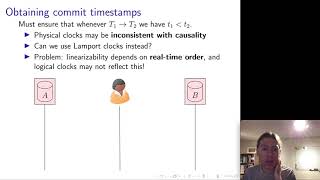
Consequently, physical wall clocks cannot guarantee causality in distributed systems. If Node A writes record X at physical time t1, and sends a message to Node B who writes record Y at physical time t2, clock skew can cause t2 < t1. Relying on physical timestamps for Last-Write-Wins (LWW) silently corrupts data.
Google Spanner's TrueTime API: Bounding Uncertainty
Under the Hood: Lamport Timestamps & Vector Clocks
1. Lamport Timestamps (Causal Ordering)
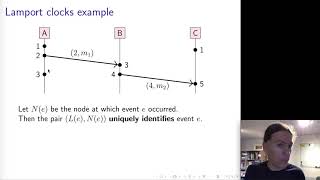
Each process maintains a single integer counter L. When an event occurs locally, L = L + 1. When sending a message, the process attaches L. When a process receives a message with timestamp Lmsg, it sets its local counter: L = max(L, Lmsg) + 1. If event A caused event B, then L(A) < L(B). However, identical Lamport timestamps do not tell us whether events were concurrent.
2. Vector Clocks (Detecting Concurrency & Conflicts)
In a cluster of N nodes, every node maintains a vector of N integers: V = [v1, v2, …, vN]. When node i mutates state, it increments V[i]. When comparing two versions VA and VB:
- If every element of VA ≤ VB and at least one is <, then VA causally preceded VB.
- If VA has components greater than VB and vice versa, the updates are concurrent conflicts that must be resolved via application merging (Dynamo sibling reconciliation).
Worked example: how big is skew, really?
- Quartz drift: typical server oscillators are specified at about 10-50 ppm. 20 ppm is 1.7 seconds per day of drift if left unsynchronized, so clocks must be disciplined continuously.
- NTP over the internet: tens of ms of error is typical. Within a datacenter with chrony: often under 1 ms. PTP with hardware timestamping (AWS Time Sync, Meta's PTP rollout): microseconds.
- Spanner TrueTime: the uncertainty epsilon sawtooths between about 1 and 7 ms (average about 4 ms in the 2012 paper). Commit-wait therefore adds a few ms per write.
Lamport timestamps step by step
| Event | Node A clock | Node B clock |
|---|---|---|
| A local write | 1 | 0 |
| A sends message (carries 1) | 2 | 0 |
| B local write | 2 | 1 |
| B receives message: max(1, 2) + 1 | 2 | 3 |
| B writes reply | 2 | 4 |
The reply (4) is guaranteed to sort after the original send (2), whatever the wall clocks say. Ties are broken by node ID to produce a total order.
Choosing an ordering tool
| Tool | Size | Gives you | Used by |
|---|---|---|---|
| Wall clock / Snowflake | 64 bits | Rough order, human-readable time | Twitter, Discord IDs |
| Lamport clock | One integer | Total order consistent with causality | Consensus logs, simple replication |
| Vector clock | One counter per node | Detects concurrent (conflicting) writes | Dynamo, Riak (dotted version vectors) |
| Hybrid logical clock | 64 bits (physical + logical) | Close to wall time and causally consistent | CockroachDB, YugabyteDB, MongoDB cluster time |
| TrueTime | Interval | External consistency (real-time order) | Google Spanner |
Failure modes
- Leap seconds and NTP steps: historical outages (2012 Linux leap-second bug). Use leap smearing (Google, AWS).
- VM pause or live migration: a process can resume seconds later without noticing. Leases based on local time must account for this, which is the motivation for fencing tokens.
- Cassandra LWW: writes carry client or coordinator timestamps, so a skewed client can make a delete lose to an older write or vice versa.