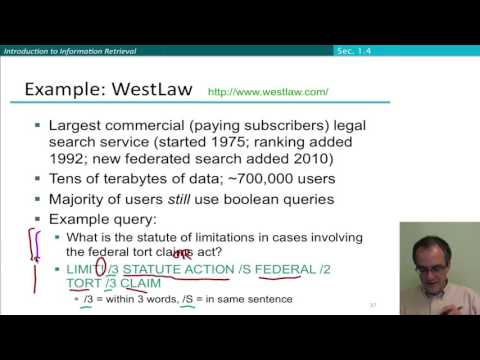


Boolean and tiered search
A reader searches for cache index, and none of our documents contains both words. Returning nothing is defensible if both words are requirements. Returning separate cache and index lessons is defensible if the reader is exploring a topic. The service needs to choose that behavior explicitly before a score decides which document looks best.
We'll keep required filters fixed, group strict and partial matches, and use term coverage or proximity when two groups are too coarse.
Requirements and preferences
The posting-list lesson gave you posting lists and two ways to combine them. Requiring every query term uses their intersection, commonly expressed as AND. Accepting any query term uses their union, expressed as OR. These operators describe a matching condition; they do not measure how useful the resulting documents are.An unknown token makes an AND intersection empty because its posting list is empty. An OR union can still contain documents matching the remaining tokens. That difference is often hidden behind a search box, but it changes what a successful response means. The user who typed a precise part number may be poorly served by a result that matches only its accompanying description.
A condition supplied as a structured filter deserves separate treatment. An allowed-document set represents which documents may be exposed in this exercise. It is chosen test input, not an authentication implementation. Every retrieval tier intersects its candidates with that same set, so relevance fallback cannot turn an excluded document into a permitted one.
Which conditions may relax?
Treat permissions and explicitly required filters as hard constraints. Treat an exploratory free-text query as a possible source of soft preferences when the interface says broader matches may appear. For a caller using an explicit “all words” search, keep AND semantics unless they request a broader search. A quiet fallback would make the response disagree with the request.
The alternatives are to return only strict matches, present broad matches separately, or mix all matches under one score. The last option is convenient, but a high score could put a partial match above a complete match unless the ranker also enforces the requirement. Choose separate ordered groups here because the behavior stays inspectable before we introduce numerical ranking.
Ordered fallback groups
A group that runs under a particular matching rule is a tier. Our chosen policy first collects all permitted AND matches as tier zero. It then collects permitted OR matches that have not already appeared as tier one. The displayed response always appends the second tier, even when the first is nonempty; this differs from a policy that broadens only after an empty strict result.
Within each tier, identifiers sort ascending. A document appears once, under the earliest rule it satisfies. Later scoring may change order within a tier, but it may not move a tier-one document ahead of a tier-zero document under this contract. If the product wants that movement, it has chosen a different contract and should evaluate it as such.
Choose the default from what the caller asked for:
| Caller situation | Default | Reason |
|---|---|---|
| Every submitted word is required | AND only | Preserve the requested condition |
| Exploring with useful partial matches | AND tier, then labeled OR tier | Keep complete matches first |
| Any term is independently sufficient | OR with ranking | No complete-match priority promised |
One policy against several queries
The allowed set contains d1, d2, d4, d5 and d8. Documents d3, d6 and d7 remain in the corpus but are excluded from this response. The exclusion is deliberately visible so you can follow a broadening attempt without confusing candidate generation with access permission.
The shared Python replay executes the rules directly against the eight chosen documents. In the capture, each tuple pairs a document identifier with its tier number. Empty input has an explicit empty-result rule, so it does not turn into a request for every permitted document.
python3 public/course-assets/system-design/m16-search.py boolean'cache stores': AND=['d1'] OR=['d1', 'd2', 'd4'] tiers=[('d1', 0), ('d2', 1), ('d4', 1)]
'cache index': AND=[] OR=['d1', 'd4', 'd5', 'd8'] tiers=[('d1', 1), ('d4', 1), ('d5', 1), ('d8', 1)]
'queue cache': AND=[] OR=['d1', 'd4'] tiers=[('d1', 1), ('d4', 1)]
'': AND=[] OR=[] tiers=[]
all tiers retain allowed ids: ['d1', 'd2', 'd4', 'd5', 'd8']For cache stores, d1 belongs to both raw sets but appears only in tier zero. The second group contains d2 and d4; retaining d1 again would make a later limit or evaluation count the same document twice. Deduplication belongs before the response is bounded or measured.
For cache index, the strict group is empty, so every result is a broader match. The response still carries tier one on each identifier. A UI can label that group “Matches some words” instead of presenting it as if every word had matched. The backend has already retained enough information for that explanation.
For queue cache, broader search still cannot expose the queue documents. Both are outside the allowed set. An empty strict result does not distinguish an absent document from an excluded one, and the public response should not reveal hidden document text to explain the difference. A diagnostic view needs its own access boundary.
Work limits and missing answers
Taking the first few candidates before deduplication can fill the response with repeats. Taking a global score sort after grouping can erase tier priority. The two-tier replay retains the complete small result and therefore avoids both interactions. If you add a limit, apply it to the final deduplicated ordered sequence and document whether a nonempty strict tier may leave space for broader results.
Choose strict retrieval for explicit requirements, and ordered broader groups for this exploratory course search. Revisit that choice when search evaluation supplies judgments showing which returned documents actually answer the intended question. A larger candidate set can recover a useful document and can also add irrelevant ones; result count alone cannot choose between those effects.
More than two tiers
For a longer query, OR groups very different matches together. A four-term query can use four coverage levels: all four, any three, any two, then any one. Each document belongs to its highest satisfied level and appears once. Repeated query words do not create extra requirements in this chosen policy.
For database index maps rows, d5 contains all four terms. No document contains exactly three. d2 contains database and rows, while d8 contains only index. The replay's additional coverage example returns the best two documents from those ordered groups:
python3 public/course-assets/system-design/m16-search.py coveragequery='database index maps rows' distinct terms=4
all coverage tiers: [('d5', 4), ('d2', 2), ('d8', 1)]
limit 2: [('d5', 4), ('d2', 2)]Here the number is matched-term count, not the earlier zero/one tier label. A real ranker can use BM25 within each coverage level while keeping the level as the primary ordering key. A boost alone does not guarantee that ordering.
A production query can require a minimum number of optional clauses. For example, Elasticsearch's minimum_should_match controls eligibility; it does not automatically implement this sequence of ranked groups. When combining text clauses with a required filter, set that minimum explicitly if text must match. A bool query with a filter otherwise defaults to zero required should clauses.
Choose whether to fetch every group or only broaden until the page is full. The replay counts all eligible candidates, sorts and then limits; it does not save retrieval work through early stopping. A staged implementation can reuse postings, exclude seen IDs and stop once enough results are retained. Keep query, filters and ordering stable across pagination so broadening does not introduce repeats or skip earlier groups.
Presence, proximity and fields
Matching all the words does not mean matching their relationship. cache stores is adjacent in d1; cache copies occurs there with stores between them. Both pass AND. Only the first passes a zero-gap phrase condition. A positional check can require adjacency or allow a defined window, with ordered and unordered windows answering different questions.
Use phrase or proximity evidence within a tier when nearby words better express the intent. Requiring a phrase is stricter than giving it a ranking preference. Preserve that distinction when broadening: quoted words should not silently become unrelated words anywhere in a document.
Fields matter too. Requiring all terms in a title differs from allowing one in the title and another in the body. In Elasticsearch, multi_match with best_fields applies AND inside each field. A term-centric query such as combined_fields can match terms spread across compatible fields. Choose the intended rule before tuning title boosts.
An empty strict result can signal a typo, missing synonym, absent source item, unavailable inventory or indexing lag. Record enough internal diagnostics to distinguish them. Increasing breadth is useful only when the extra documents answer the need. The query-understanding lesson changes which terms are searched; the next lesson orders equally eligible documents with a specified numerical baseline.
Under the Hood: Multi-Term Boolean Evaluation
When users search for multi-word queries (e.g. "distributed consensus raft"), the search engine parses the query into a boolean expression tree combining MUST (AND), SHOULD (OR), and MUST_NOT (NOT) clauses.
A separate optimization: quality-tiered indexes
Some designs use tiers for matching policy: complete AND matches precede broader OR matches. The optimization below is different: it partitions documents by a precomputed quality class to reduce search work. Do not use a quality tier to relax required terms or authorization filters.
Under the Hood: Tiered Indexing Mechanics
- Quality Tiers: Rather than forcing every query to search the entire multi-billion document corpus, documents are partitioned into quality tiers based on static quality scores (PageRank, click popularity, freshness, seller reputation).
- Tier 1 (Hot Core): Contains top 10% highest-quality documents, stored on ultra-fast NVMe SSDs or pinned in RAM. For many workloads a large share of head queries can be satisfied entirely within Tier 1, but the hit rate is corpus- and product-specific and must be measured.
- Tier 2 & 3 (Cold Archive): Contains long-tail documents on dense hard drives. The query engine only cascades to lower tiers if the top-tier match count is below the desired result threshold.
Worked example: ordering a three-term AND
Query: distributed AND consensus AND raft on a 100 million document corpus. Document frequencies:
| Term | Postings length |
|---|---|
| distributed | 2,000,000 |
| consensus | 50,000 |
| raft | 8,000 |
Rarest first: intersect raft with consensus. A linear merge touches at most 58,000 entries and yields, say, 5,000 documents. Now intersect those 5,000 with distributed. A linear merge would walk 2,005,000 entries, but with skip pointers or galloping search each of the 5,000 probes costs roughly log2 of 2,000,000 divided by 5,000, about 9 steps, so around 45,000 steps. Total: about 100,000 steps.
Query order: starting with distributed AND consensus means walking at least 2,050,000 entries before raft is even considered, over 20 times more work for the same answer.
Worked example: tier cascade
Tier 1 holds the top 10 percent of documents by static quality, 10 million docs, in RAM. The user wants 20 results. If tier 1 returns at least 20 matches for all MUST clauses, stop. If it returns 7, query tier 2 and merge. Because head queries tend to be broad, most of them are satisfied by tier 1, while long-tail queries fall through; the exact hit rate depends on the corpus and should be measured rather than assumed.
Trade-offs
| Technique | Speeds up | Costs |
|---|---|---|
| Rarest-first ordering | AND queries | Needs document frequency stats, which are cheap |
| Skip pointers or block skipping | Short list vs long list merges | Extra index space; little gain for equal-length lists |
| Quality tiers | Broad head queries | Possible recall loss; cascade adds latency when tier 1 is insufficient |
| Early termination on impact-ordered postings | Top-K ranking | Harder updates; scores must be precomputable |
Lucene implements AND as a conjunction that leads with the lowest-cost iterator and advances the others to its current doc ID, which is the rarest-first strategy in code form. Web engines historically used tiered indexes keyed on PageRank-like static scores.